Gilbert F. White National Flood Policy Forum (2010)
Managing Flood Risks & Floodplain Resources
Forum 2010 Sponsors
Symposium 1 Sponsors
Symposium 2 Sponsors
|
The ASFPM Foundation took up flood risk as the issue for the 3rd Gilbert F. White National Flood Policy Forum. In fact, when the Events Planning Committee began to ponder the program plans, they found it to be such a comprehensive and complex subject that they broke it into three segments in order to properly tackle the topic. Symposium 1 in September addressed quantification through the theme, "Defining and Measuring Flood Risks and Floodplain Resources.” Symposium 2 in November dealt more with communicating, via the theme, "Flood Risk Perception, Communication and Behavior.” The background information and common understandings garnered focused the 2010 forum in March on "Flood Risk Management.” The series was by invitation only as in previous forums.
 Flood Risk Management Forum Final Report
Flood Risk Management Forum Condensed Report
 Flood Risk Management Forum. Series overview and introduction to the 3rd Gilbert F. White Flood Policy Forum.
Perspectives on Floodplain Management: Yesterday, Today, Tomorrow. Dr. Gilbert F. White speaks at the Buyouts Workshop in Davenport, Iowa, January 1994.
Assembly
The challenges facing the third assembly of the Gilbert F. White National Flood Policy Forum was to solidify a cohesive vision of the fundamental components of a flood risk and resources management strategy for the nation, and to identify the steps that must be taken to develop and implement such a strategy.
More than 60 invited papers on this topic have been collected within the background material document, roughly grouped into five categories—although most papers adopted a broad perspective and could properly have been placed in more than one category. These background papers set out the thinking of experts in the field as they ponder whether a risk management approach will be an appropriate and more effective way to managing floods and floodplain resources in the future. If so, what would such a framework entail, what should it seek to achieve, what obstacles must be overcome? The thinking presented in these papers underlay the discussion at the forum.
Part 1. Outcomes and Indicators: Recognizing Progress
Part 2. Communication: Human Behavior, Perception, Messages
Part 3. Management Strategies: In Place and Envisioned
Part 4. Data and Tools for Managing Flood Risk and Floodplain Resources
Part 5. National Policy and Programs: Ideas and Suggestions for Change
Overview of "Flood Risk Management," 2010 Gilbert F. White National Flood Policy Forum
Background Material (large file, 4.6MB)
Assembly Agenda
Participants List
 Photos from the Assembly
Assembly Presentations
Video recordings of the presentations may be accessed through our YouTube channel.
Scott Edelman, then ASFPM Foundation president, AECOM
 Welcome and Introductions
Sam Riley Medlock, Policy & Partnerships Program Manager, ASFPM
Forum Topic and Process
Jeanne Christie, Executive Director, Association of State Wetland Managers
Challenges in Managing the Natural and Beneficial Resources
Dennis Mileti, Professor Emeritus, University of Colorado-Boulder
Behavior Factors and How to Effect Change in Flood Mitigation
Doug Plasencia, ASFPM Foundation Trustee; Michael Baker, Jr., Inc.
Setting the Stage for National Flood Risk & Resources Policy and Strategies
Symposium 1
"Defining and Measuring Flood Risks and Floodplain Resources" seeks to identify the most effective operational definition(s) of flood risk and the methods for quantifying the risks floods pose and the benefits and resources flooding can bring.
Background Material
Symposium 1 Agenda
Quantifying Flood Risk - Gregory Baecher, The Water Collaborative at the University of Maryland
The Need for a Resource Conservation Ethic in Flood Risk Management - Doug Plasencia, Jacquelyn L. Monday
Participants List
Symposium 2
"Flood Risk Perception, Communication, and Behavior." Using consensus recommendations on the best definition of and methods for quantifying flood risks and benefits (generated at the first symposium), the second symposium, "Flood Risk Perception, Communication, and Behavior,” worked to reach agreement on the best methods to get the public and decision makers to take appropriate steps to manage and otherwise cope with flooding. A major research project has confirmed that individual and household behaviors to mitigate and/or cope with the threat of natural hazards and/or terrorism are not influenced by an understanding of the actual risk of such events and/or their consequences. Rather, appropriate coping behaviors, such as preparedness and mitigation, are the result of a range of other factors identified in that study. Therefore, the earlier belief that people would take action to avoid or reduce flood risk if only they understood it better, is not well-founded. Consequently, any sweeping effort to develop better ways of identifying and conveying risk are highly unlikely to have the desired effect, as least insofar as households and individuals are concerned.
That research did not investigate collective behavior, i.e., decision making at local, state or federal levels. How to foster appropriate collective behavior is significant to floodplain management because many of the most effective mitigation techniques (land use, building codes, open space maintenance) cannot be carried out individually. So separate consideration needs to be given to how collective decisions about risk and environmental issues are made and can be influenced.
Background Material
Symposium 2 Agenda
Matrices
"Increasing Public Awareness for Flood Disasters" - Dr. Dennis Mileti
Participants List
States Symposia, April 2011
Two follow-up state symposia were held in Indianapolis, Indiana, April 12, 2011 and Boulder, Colorado, April 14, 2011. Here is the report on their discussions and observations as an appendix to the 2010 Forum.
States Symposia, March 2013
Two additional follow-up state symposia were held in Austin, Texas, March 19, 2013 and Atlanta, Georgia, March 21, 2013. Here is the report on their discussions and observations as a second appendix to the 2010 Forum.
|
Thanks to the Forum Sponsors!
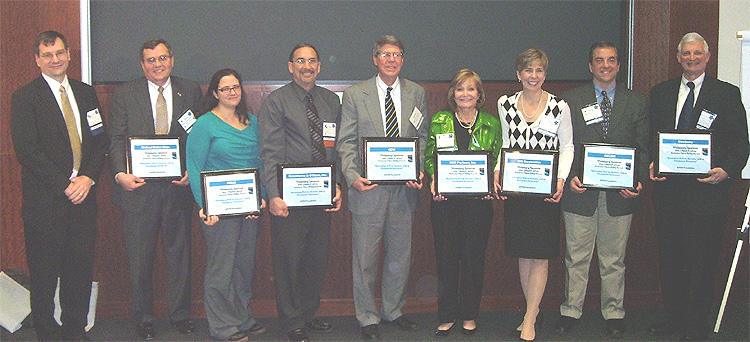 Pictured left to right: Scott Edelman, past ASFPM Foundation President; David Greenwood, Michael Baker Corp.; Jen Marcy, PBS&J; Vince DiCamillo, Greenhorne & O'Mara; Mark Dunning, CDM; JoAnn Howard, H2O Partners; Ann Terranova, URS; Matt Koch, AECOM; Grant Smith, Dewberry. Not pictured: David Key, ESP Associates, PA; Don Armour, Stantec Consulting, Inc. |